The National Joint Procurement Office is soliciting oral specialty medical institutions to participate in the formulation of VBP rules; endodontic treatment material company Longly Biotechnology is l…
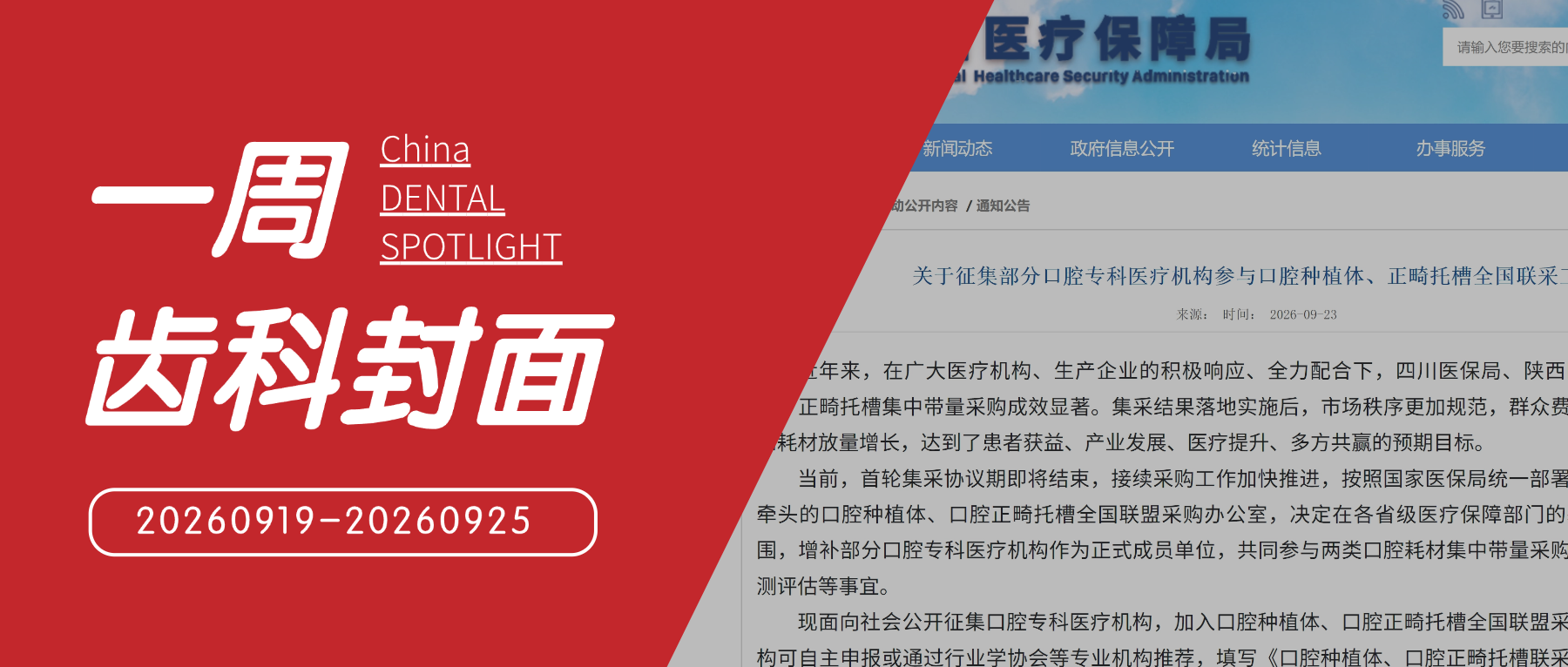 |
National Joint Procurement Office Seeks Dental Specialty Institutions to Participate in VBP Rule-Making and Effectiveness Monitoring
On September 23, 2026, the Healthcare Security Administrations of Sichuan Province and Shaanxi Province jointly issued an announcement, seeking dental specialty institutions nationwide to join the National Joint Procurement Office and participate in the research and formulation of VBP rules for dental implants and orthodontic brackets, as well as effectiveness monitoring. Applicants must send the application form to the designated email address by September 30, 2026.
Longly Biotechnology Lists on NEEQ, Endodontic Treatment Materials Revenue Reaches RMB 45.8832 Million in 2025
Starting September 23, 2026, Longly Biotechnology (Wuhan) Co., Ltd. was listed on the basic tier of the National Equities Exchange and Quotations (NEEQ), under the securities abbreviation "Longly Biotechnology" with the code 875256. The company reported operating revenue of RMB 69.5603 million in 2025, a year-on-year increase of 14.94%, with a gross margin of 80.83%. Its sales model is primarily distribution-based, with distribution revenue accounting for 99.05% and 99.26% of main business revenue in 2024 and 2025, respectively.
SAMR: Cost Investigations and Price Inspections for Enterprises Engaged in Malicious Low-Price Competition, Strict Handling in Accordance with Law
On September 20, 2026, the State Council Information Office announced at a press conference that the State Administration for Market Regulation (SAMR) will conduct cost investigations and price inspections of enterprises engaged in malicious low-price competition and handle them strictly in accordance with law. As of the end of August, 29,000 cases of inferior and low-priced products had been investigated and handled nationwide, and full-chain, whole-process regulation of pharmaceuticals will be upgraded. During the "15th Five-Year Plan" period, price enforcement will be strengthened, the revision of the Price Law will be accelerated, and the revision of the "Provisions on Prohibiting Predatory Pricing" will be studied, promoting the formation of a "1+1+N" legal framework for regulating predatory pricing.
Foshan Dental Devices Exports Reach RMB 590 Million in January-August 2026, Up 15.5% Year-on-Year
According to a report by the Finance Channel of China Media Group, statistics from Foshan Customs show that from January to August 2026, Foshan's dental device exports reached RMB 590 million, a year-on-year increase of 15.5%, sold to 129 countries and regions, with growth in the European market exceeding 40%. Six out of every 10 dental chairs and 7 out of every 10 dental handpieces worldwide are produced in Foshan, where nearly a thousand upstream and downstream enterprises cluster, forming a "one-stop complete supply" chain. Relying on technological innovation, Foshan's dental device industry is accelerating its layout in the high-end global dental market.
China's Oral Care Category Online Sales Up 13.3% Year-on-Year in H1 2026, Children's Oral Care Fastest-Growing Segment
On September 19, 2026, the China Oral Care Industry Association (COCIA) released industry operating data for January-July 2026: above-scale enterprises in the oral cleaning products manufacturing industry achieved revenue of RMB 18.4 billion, a year-on-year increase of 8.4%; total profits reached RMB 2.2 billion, up 8.9% year-on-year, but growth dividends are highly concentrated among leading players, with the number of loss-making enterprises increasing from 18 to 26. Data from the Association and Shangzhizhen show that in H1 2026, China's oral care category online sales reached RMB 10.63 billion, a year-on-year increase of 13.3%. In addition, children's oral care is the fastest-growing segment with the most significant policy support; pet oral care has emerged as a new growth point.
Superline Technology: Terminates Directed Share Issuance
On September 14, 2026, Superline Technology issued the "Announcement of Resolutions of the Second Extraordinary Shareholders' Meeting of 2026," with shareholders unanimously approving the termination of the previously planned 12-month directed share issuance. The company achieved operating revenue of RMB 42.3015 million in H1 2026, with net profit of RMB 614,200, down 71.47% year-on-year. The sharp decline in net profit was due to new products still in capacity ramp-up, resulting in elevated unit costs.
New Guidelines for Orthodontic AI Governance: American Association of Orthodontists Clarifies "Human-in-Command" Authority and Responsibility Boundaries
In September 2026, the American Association of Orthodontists (AAO) released a position paper titled "Responsibly Integrating Artificial Intelligence into Clinical Care," clarifying that orthodontists are the final decision-makers and responsible parties in AI-assisted diagnosis and treatment, proposing the "human-in-command" (HIC) principle and a six-pillar governance framework covering risk oversight, full-lifecycle transparency, patient autonomy, AI education, operational integration, and data privacy. The document states that the regulatory classification of orthodontic AI software depends on its function: CDS-type tools are not medical devices, while those directly driving clinical operations may be classified as Software as a Medical Device (SaMD) and subject to FDA regulation. The document emphasizes the need to enhance AI literacy through systematic training and recommends adopting standards such as HL7 FHIR and DICOM to ensure data security.
Investment Firm FP Acquires Dental AI Patient Engagement and Payment Platform Weave for USD 650 Million
Recently, investment firm Francisco Partners (FP) acquired dental AI patient engagement and payment platform Weave Communications for approximately USD 650 million, at USD 7.40 per share, a premium of approximately 34% over the closing price on August 17, 2026, covering more than 40,000 dental clinics. The transaction is expected to close in Q4 2026, subject to approval by Weave shareholders and regulatory authorities.
Biotech Company Secures USD 4 Million in Financing to Accelerate Enamel Repair and Bone Regeneration Technology Development
Recently, UK biotech startup Eterna Regeneratives completed a USD 4 million seed round financing, led by Hoxton Ventures and The Venture Collective, with funds earmarked to accelerate the development of wool keratin-based enamel repair and bone regeneration technologies, and plans to launch an enamel repair product in early 2027. The company has expanded its research and commercial teams and established partnerships with oral care companies and professional partners.
Korean Dental Robotics Company Completes Seed Round Financing to Advance Development and Commercialization of Autonomous Saliva Ejector Robot
On September 21, 2026, Korean startup Dental Robotics completed a seed round financing led by AI Angel Club, with the amount undisclosed, and funds will be used for prototype development of an autonomous saliva ejector robot. According to company disclosures, the robot achieves 100µm-precision oral modeling, with a 98.6% alignment success rate in 210 test cases, equipped with 50g-class pressure-sensitive sensors, compliant with relevant standards. The company plans to complete Class II medical device approval and commence commercialization by 2028.
Approximately 46,000 Patients' Health Information Breached, U.S. Dental Chain Hit by Cyberattack
On July 19-20, 2026, Hawaii dental chain Hawaii Family Dental was hit by a cyberattack, with approximately 46,000 patients' names, phone numbers, addresses, dates of birth, dental treatment records, and health insurance information accessed without authorization; highly sensitive information such as Social Security numbers was not compromised. The company has isolated affected systems and strengthened network defenses, and subsequently filed breach reports with regulatory authorities including the HHS Office for Civil Rights (HHS OCR).
U.S. Dental Insurance Reform Laws Reach 400, with 33 New Laws Added in 2026
On September 22, 2026, the American Dental Association (ADA) announced that dental insurance reform legislation nationwide has reached 400 laws, with 33 new laws across 18 states, focusing on key issues such as network leasing, virtual credit cards (VCC), and assignment of benefits (AOB). ADA President Richard Rosato noted that these achievements reflect the critical role of dental professional organizations in promoting transparency and fairness.
National Institutes of Health Establishes New Research Center to Explore Alternatives to Root Canal Treatment
On September 23, 2026, the National Institutes of Health (NIH) allocated approximately USD 2 million to jointly establish a National Dental Practice-Based Research Center with the University of Texas at San Antonio and the University of Alabama at Birmingham, aiming to promote pulpotomy nationwide as a conservative alternative to root canal treatment. The project launched on September 1, 2026, with the first year focused on investigating barriers to dentist adoption of the technique and designing targeted curricula. If benchmarks are met, it will proceed to a three-year multicenter clinical trial phase.
New Study: Silver Diamine Fluoride May Arrest Caries Progression in 54% of Young Children, but Causes Permanent Tooth Darkening
Recently, JAMA Pediatrics published a Phase III randomized controlled trial involving 830 children under age 6 with severe early childhood caries. After a single application of 38% silver diamine fluoride (SDF), the 6-month lesion arrest rate (LAR) reached 54.0%, significantly higher than the control group's 22.5%; at 8-month follow-up, the caries arrest rate remained at approximately 50%. Adverse event rates were similar between the two groups, and teeth permanently turn dark brown or black after SDF treatment. The therapy has been FDA-cleared for dentin hypersensitivity since 2014, but its use for caries arrest remains off-label.
| About DGN:DentalGoodNews (DGN) is a trusted professional media platform dedicated to the global dental industry. We deliver in-depth coverage of corporate news, policy & regulation, investment & funding, and clinical frontiers — serving dental institutions, device manufacturers, investors, and industry researchers worldwide. Contact us: haodeya@dongxizixun.com |

;)