U.S. Federal Court Rules for First Time on Dental Service Organization (DSO) Case Involving AI Call Recording
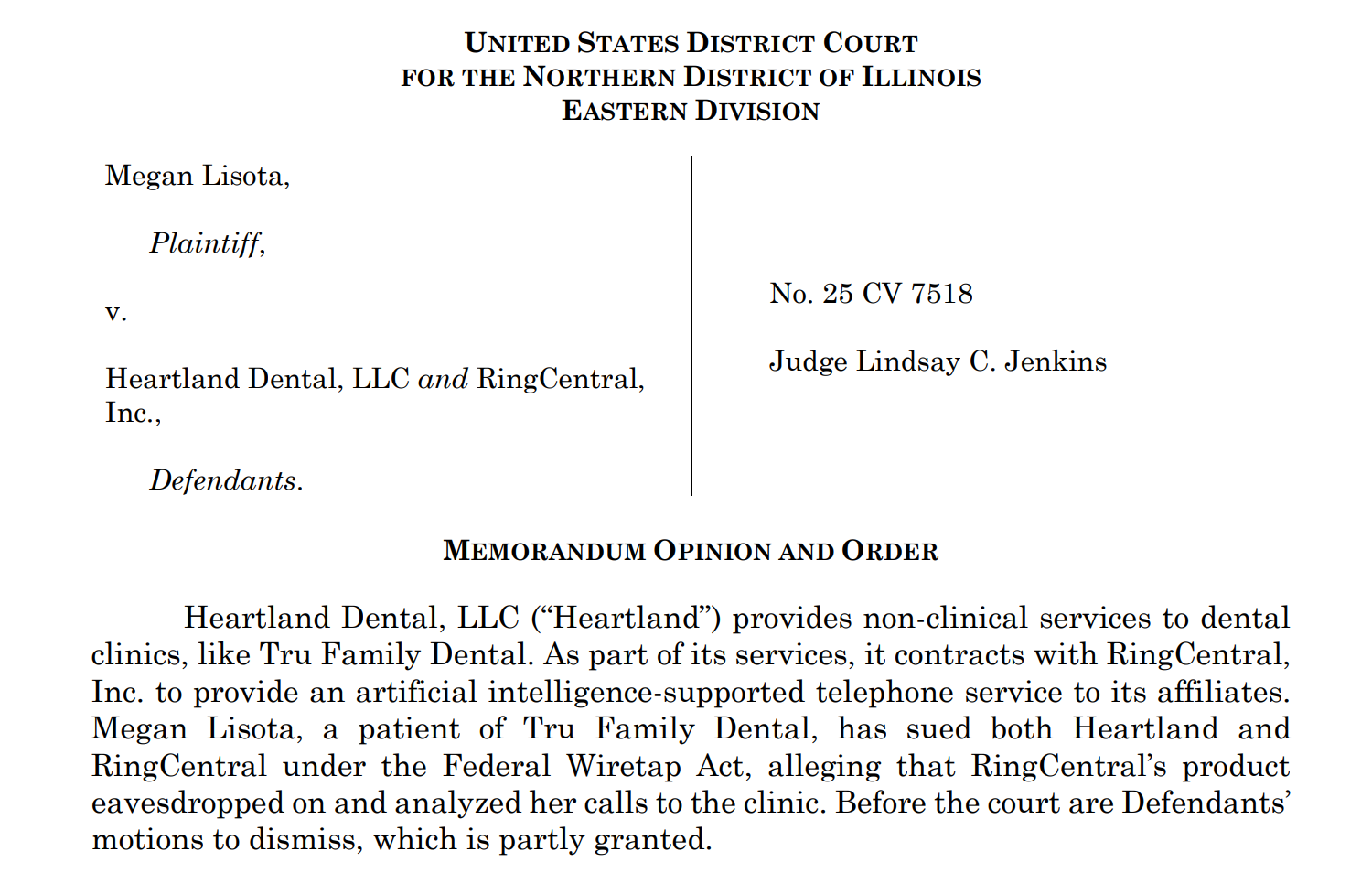 |
| Image Source: United States District Court for the Northern District of Illinois |
DentalGoodNews | On January 13, 2026, the United States District Court for the Northern District of Illinois issued a memorandum opinion in the case of Lisota v. Heartland Dental and RingCentral. The court procedurally dismissed (without prejudice) the plaintiff's claim under the Federal Wiretap Act for "failure to state a claim upon which relief can be granted." This is one of the early federal-level memorandum opinions found to date concerning litigation arising from a Dental Service Organization's (DSO) use of AI call analysis tools.
This case originated from Heartland Dental's engagement of RingCentral to perform real-time AI transcription and analysis of patient calls. The plaintiff, Lisota, alleged that their call content was recorded and processed by the AI system without explicit notification, violating the two-party consent provision of the Federal Wiretap Act. Heartland Dental is one of the largest Dental Service Organizations (DSOs) in the United States, supporting over 1,800 affiliated dental practices.
The court's memorandum opinion noted that the plaintiff failed to adequately articulate the respective legal roles of Heartland Dental and RingCentral in the AI call processing and did not specifically state which call contents were intercepted or the method of interception. The court procedurally dismissed the lawsuit, allowing the plaintiff to amend the complaint and refile. As of the publication deadline, the plaintiff has not publicly indicated whether they will file an amended complaint.
Proceeding concurrently with this case is the class-action lawsuit Saucedo v. Sharp HealthCare in California. The plaintiffs in that case allege that Sharp HealthCare used an AI note-taking tool named Abridge to record patient-provider conversations without obtaining valid patient consent. That case is still pending in federal court, with no substantive ruling issued yet.
On the legislative front, two state-level regulations have taken effect. California's AB 3030, effective January 1, 2025, requires healthcare providers to provide written disclosure when using generative AI to communicate with patients. Texas's SB 1188, effective September 1, 2025, codifies the obligation to inform patients about AI-assisted decision-making in healthcare settings. Both regulations apply to healthcare providers using AI tools for patient communication, clinical documentation, or diagnostic assistance.
At the federal regulatory level, the U.S. Federal Trade Commission (FTC) included AI chat products in its priority investigation scope for 2025, focusing on whether such AI tools lack adequate measures to mitigate potential harm to users, especially minors. It is reported that several technology companies providing AI call analysis services have received inquiry letters from the FTC.
| About DGN:DentalGoodNews (DGN) is a trusted professional media platform dedicated to the global dental industry. We deliver in-depth coverage of corporate news, policy & regulation, investment & funding, and clinical frontiers — serving dental institutions, device manufacturers, investors, and industry researchers worldwide. Contact us: haodeya@dongxizixun.com |

;)